 |
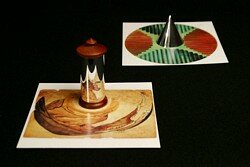
Anamorphosis Ref: LH-A407
The distorted forms or anamorphosis was a very popular instrument during the XIX century. It consists of hidden figures appearing when projected on a reflecting surface, as a cylinder, cone or pyramid.
Although the terminology "anamorphosis" was first used in the XVII century, Leonardo Da Vinci described it on his notes.
Manierism (Europe 1530-1600) was totally characterised by distorted forms. Painters showed special interest in objects distorted by convex mirrors. In this art context, the anamorphosis took place and as a clear example, please refer "The Embassadors" (detail on the sword) by Hans Holbein.
Curious tip: You can download a programme from the Internet (www.anamorphosis.com) that allows you see the anamorphosis in your own images.
Price: £34.99 (Including: VAT at 17.5%)
|
|
|
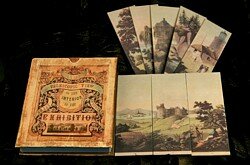 |
Myriorna Ref: LH-A406
The "Myriorama" was a very well-known entertainment during the XIX century. The first publish Myriorama is dated on 1830 in Leipzig.
This game contains eighteen illustrations which can be mixed together randomly and will show thousands of different landscapes.
Price: £14.99 (Including: VAT at 17.5%)
|
|
|
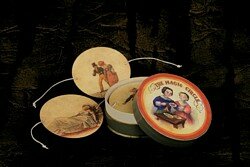 |
Taumatropo Ref: LH-A405
The taumatrope is an optical instrument which was produced for the first time by John Ayrton Paris in England on 1824. His aim was to prove that retina is inclined to persist in a course of action or movement.
It contains a disc with two different images in each side and two tied ropes. When pulling the ropes, both sides of the disc will come together in one image.br> The taumatrope was the precedent to other instruments like zootrope or praxinoscope, which are precursors of the cinemascope.
Price: £10.99 (Including: VAT at 17.5%)
|
|
|
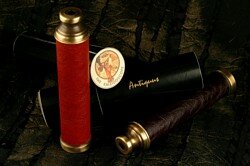 |
Kaleidoscope (Leather) Ref: LH-A408
This product is an optical instrument invented by David Brewster in 1816. By the following years it was very well known in all Europe.
It consists of a cylinder whose interior is filled with small portions of coloured glass. The reflection of these pieces on three flat mirrors creates endless combinations with different shapes when turning. Beauty, colour and variety have inspired artists and their creativity.
This Kaleidoscope is actually a copy of the original Kaleidoscope dated in 1874 and found by "Antiquus" at an Antique Market in Prague.
Price: £31.98 (Including: VAT at 17.5%)
|
|
|
|
Kaleidoscope (Paper) Ref: LH-A409
This product is an optical instrument invented by David Brewster in 1816. By the following years it was very well known in all Europe.
It consists of a cylinder whose interior is filled with small portions of coloured glass. The reflection of these pieces on three flat mirrors creates endless combinations with different shapes when turning. Beauty, colour and variety have inspired artists and their creativity.
This Kaleidoscope is actually a copy of the original Kaleidoscope dated in 1874 and found by "Antiquus" at an Antique Market in Prague.
Price: £29.99 (Including: VAT at 17.5%)
|
|
|
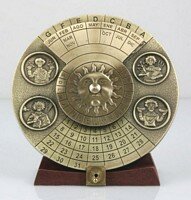 |
Perpetual Calender Ref: LH-H27
Only perpetual calendars meet the basic condition of permitting the deduction of any essential data from any other data (year, month, week and day). However, all the analogue perpetual calendars known are hardly perpetual since the limit of their calculations is about 50 years.
Our calendar starts at January 1, 1600, and ends at December 31, 2799. It is based on a repeating cycle of 400 years and a solar cycle of 28 years. It works by means of the "Dominical letter".
Price: £35.00 (Including: VAT at 17.5%)
|
|
|
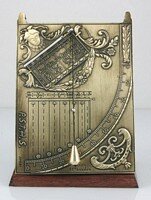 |
Quadrant - Capuccino Ref: LH-H28
The name is derived from the best known version of this solar clock, in which the path of the pearl in both tropics traces two lines that resemble the hood of Capuchin monks. The quadrant goes back to the 15th century, although the date is not precise.
This model is a sea-going, local-hour quadrant of a type called a clinometer. It is a reproduction and has been calculated for a latitude of 51.5º N
Price: £35.00 (Including: VAT at 17.5%)
|
|
|
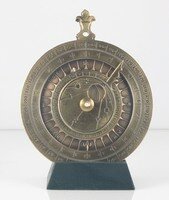 |
Nocturnal and Tide Computer Ref: LH-H31
The piece is a replica of a Nocturnal and Tide Computer from 1570, signed by Humphrey Cole. Currently this instrument can be found in the British Museum, London.
One of its faces is a Nocturnal and the other is a Tide Computer. The Nocturnal or star clock is an artifact that is used to obtain the time at night using the fixed stars in the sky. The abacus or tide computer is used to figure the time of the tides that greatly affect navigation both in harbours and for fishing.
Price: £45.00 (Including: VAT at 17.5%)
|
|






 Miniature Astronomical Ring - ideal present